

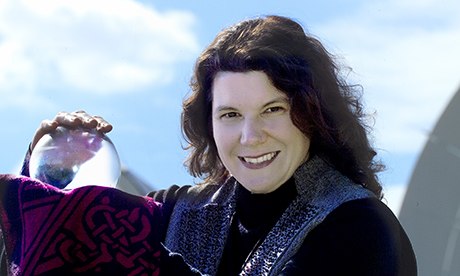
Photograph: BT Germany
Mobile communications mean knowledge-based workers will not have to work at desks in offices, says Nicola Millard. Dr Nicola Millard, 'futurologist' for BT, says office-based work is set to change.
When the American broadcaster Walter Cronkite made a programme about the office of the future he made in 1967,
he forecast the end of commuting thanks to a desk at home laden with
screens for making video calls, checking the news and tracking stock
prices. There was even a closed circuit television system for monitoring
activity in the other rooms – on Cronkite's screen, women in pinafores
were making the bed.
Over the past 40 years, the idea of
home-working has been more of an ambition than a reality for most
people. More than half of us still work in a traditional office at a
fixed desk. But Dr Nicola Millard, a futurologist working for BT
whose full-time job is to gaze ahead at how our lives are likely to
change, believes the reinvention of work is finally under way.
Millard,
who has a degree in psychology and a PhD in computer science, has
worked for BT for 23 years in research and customer service, helping to
design systems for call-centre workers, before being appointed as the
group's futurologist.
She, however, prefers to describe herself as
a "soonologist" because her job is to advise BT and its big corporate
clients on how working life will evolve over the next five years – and
she reckons we have reached a point at which the majority of people in
"knowledge-based" roles can now do their jobs with little more than a
phone, a computer and an internet connection. Work, she says, can now be
a state of mind, rather than a place. "There is no reason why knowledge
workers shouldn't all be working flexibly in five years' time," she
says. Millard reckons the wide availability of highly portable
computers, from smartphones to tablets and laptops, means that rather
than sitting at Cronkite's formal "computerised communications console"
watching maids making beds, professionals will more likely be on their
bed, working in their pyjamas.
Millard's favourite place to hunker
down and get productive is at what she calls the "coffice" – which
could be a coffee shop, hotel lobby or airport lounge: places where the
background noise provides a buzz but there are no colleagues to cause a
distraction.
"My four criteria for working are that I need good
coffee, I need good cake, I need great connectivity – the Wi-Fi wings to
fly me into the cloud – and I need company. But I don't necessarily
work in the office if I want to concentrate. I will go to the office if I
want to socialise about work."
Millard's office is BT's research
laboratory at Adastral Park in Suffolk, a pioneering centre for
technology and telecommunications, where a scale model of BT's global
network is used to test the broadband kit developed by the group and its
partners.
About 10% of BT's employees work from home, a fact that
helps well over 90% of mothers at the company return to their jobs
after maternity leave. However, 73% of BT staff are set up to work from
anywhere, with laptop access to their company files.
Much of
Millard's work is about the future of offices and business meetings, and
although we are now more mobile, video calling and conference calling
have made travelling to meetings less of an imperative. BT, she says,
has adapted Dolby surround-sound technology for conference calls and is
currently researching its effectiveness.
High definition
microphones and multiple speakers give participants audio cues that can
help replace the visual ones we usually rely on, such as facial
expressions and hand gestures.
Modulations in the tone of voice
and breathing are picked up, background sound is also transmitted,
helping to distinguish one speaker from another, and voices are arranged
in a virtual circle around the listener, with sound transmitted from
left, right or straight ahead.
Office use is changing, and with it
the design of our workplaces. One solution gaining popularity, she
says, is the "activity based office", which is zoned by need. There can
be presentation rooms, areas for socialising, pods for solo work, larger
rooms for brainstorming and even police-style incident rooms where bid
proposals are written by specially assembled teams.
Collaboration and cross-fertilisation, she says, can be promoted by assigning staff a locker instead of a desk.
In
Sydney, some offices these days have concentric circles of activities,
with quiet rooms by the windows, areas for making phone calls further in
and zones for presentations, eating and drinking at the centre,
creating a hub of activity at the heart of the collective space.
Millard,
who describes herself as a collector of offices, says: "The office is a
collaboration tool and should be designed for collaboration. The open
plan office is a product of the 1970s when we thought that by forcing
everyone together, by breathing the same air, we would collaborate. But
that's not how it works."
Technology, of course, also has its
drawbacks. The average person is interrupted every three minutes during
their working day, according to the London Business School, and our
plethora of gadgets have made for more disruptions.
Interrupted
tasks have been found to take twice as long to finish and contain twice
as many errors as uninterrupted efforts: it can take between 12 and 20
minutes to resume a complex task after being interrupted.
Our
ability to multitask has not evolved alongside the computer chip, says
Millard; the constant switching between tasks required by technology is
tiring and damages productivity.
For her, the worst distraction is
email, which she calls a "time vampire" and only checks twice a day.
For urgent communication, she uses text messages. "We have these devices
that are constantly on and constantly on us. I describe them as
screaming three-year-olds. They are always demanding our attention and
we are infinitely distractable as human beings."
In future,
working without assigned desks will help create private time for tasks
that require high levels of quiet and concentration, but that could
generate problems finding colleagues. Here again, technology is the
solution.
Tagging employees, for example with RFID
(Radio-frequency indentification) technology in staff ID cards, allows
employers to track workers.
Staff could also broadcast their arrival in the building to their social network, or check in at a particular desk using a code.
But that might be a Big Brother step too far for some.

No comments:
Post a Comment